

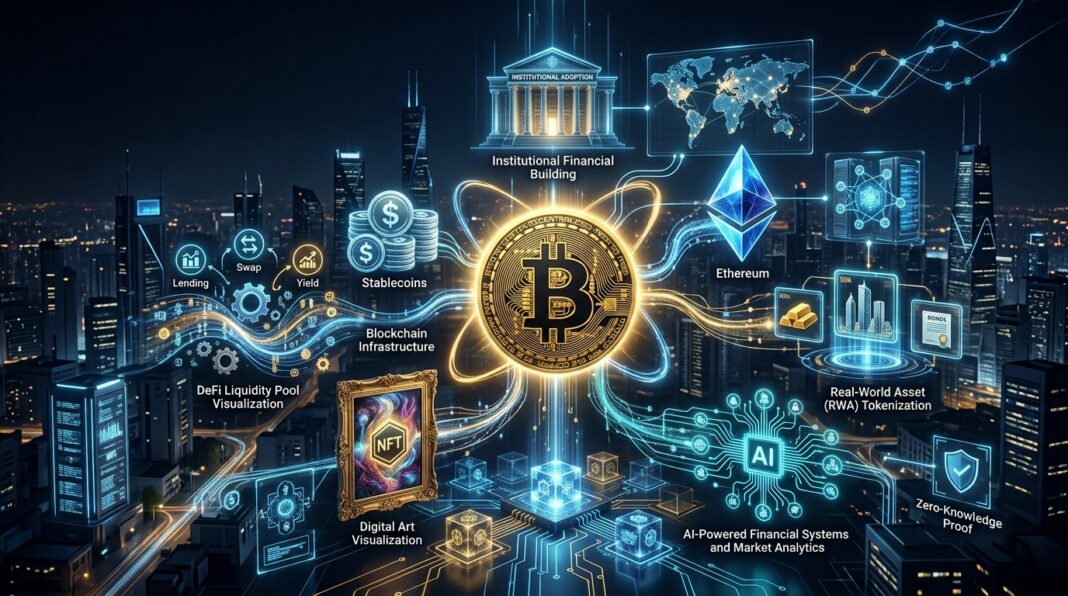

What’s Driving the Crypto Market in Mid-2026? Focus Shifts to Utility and Institutional Integration
The cryptocurrency market in mid-2026 is a place of significant transformation. Gone are the days when speculation alone drove prices sky-high. Now, the focus has firmly shifted towards real-world utility, practical applications, and the deep integration of digital assets into the traditional financial system. This evolution is being fueled by a combination of clearer regulatory frameworks, accelerating institutional adoption, and groundbreaking technological advancements.
One of the most talked-about trends is the increasing role of **Artificial Intelligence (AI)** in crypto. AI agents are no longer just a futuristic concept; they are actively managing portfolios, optimizing network infrastructure, and enhancing decision-making processes. These AI-powered tools offer increased efficiency, improved risk management, and the potential for more sophisticated portfolio optimization, allowing for proactive adjustments based on market trends and predictive models. The intersection of AI and crypto is redefining digital commerce and creating new opportunities for autonomous agents capable of holding wallets and transacting independently.
Another major theme shaping 2026 is the rise of **tokenization**, particularly the tokenization of real-world assets (RWAs). This involves converting traditional assets like real estate, art, government bonds, and commodities into digital tokens on the blockchain. This process not only makes these assets more liquid and tradable but also opens up new avenues for investment and fractional ownership. Financial institutions are actively participating in this trend, tokenizing everything from treasury bonds to private credit and real estate portfolios.
**Stablecoins** continue to solidify their position as a critical piece of financial infrastructure. They are increasingly being adopted for business payments, cross-border settlements, and treasury operations, offering a more efficient and cost-effective alternative to traditional banking systems. With clearer regulations and growing enterprise adoption, stablecoins are becoming the “internet’s dollar,” facilitating faster and cheaper transactions globally.
## The Maturation of NFTs: Utility Over Speculation
The Non-Fungible Token (NFT) market has undergone a significant evolution in 2026. The days of purely speculative profile-picture projects are largely behind us. Instead, the focus has shifted dramatically towards NFTs with demonstrable utility and real-world applications. Projects that previously focused on hype are now either defunct or have significantly lost value, while survivors are those that offer tangible benefits.
This shift is evident in the types of NFTs gaining traction. We’re seeing increased interest in “gaming NFTs” and NFTs used for “art provenance and digital certificates,” providing verifiable proof of ownership and history. Ticketing, access, membership, and licensing rights are also becoming more common use cases, demonstrating practical value beyond simple collectibility. Even brands are leveraging NFTs for marketing and customer engagement, with some projects proving they can generate offline revenue, such as through toy licensing.
While the market cap and trading volumes are more subdued compared to the peak speculative era, the number of active wallets has seen a recovery, indicating a more engaged and utility-focused user base. Major NFT collections like CryptoPunks and Bored Ape Yacht Club continue to hold significant value due to their established brand ecosystems and IP licensing, while new leaders are emerging based on real-world utility and community strength.
## DeFi’s Growing Influence and Institutional Embrace
Decentralized Finance (DeFi) continues its trajectory as a dominant force in the crypto space in 2026, moving beyond experimental phases to become an established layer of the financial system. With over $130 billion in total value locked (TVL) across protocols, DeFi is offering sophisticated financial services and alternative funding methods for businesses.
Key developments in DeFi include the activation of fee-switch mechanisms by major protocols like Uniswap and Aave, linking protocol revenue directly to token holders and creating more sustainable models. Institutional players, including major firms like BlackRock and Franklin Templeton, are actively participating by tokenizing RWAs on-chain, further bridging the gap between traditional finance (TradFi) and DeFi. Regulatory frameworks like MiCA in Europe and the GENIUS Act in the US are also taking effect, providing clearer guidelines for the DeFi ecosystem.
Mobile DeFi wallet usage has also surged, accounting for a significant portion of total users and signaling that DeFi is no longer confined to desktop experiences. This increasing accessibility and integration with real-world assets are key drivers of DeFi’s continued expansion and adoption.
## Altcoin Landscape: Selective Growth Over Broad Season
While the term “altcoin season” still circulates, the reality in 2026 is more nuanced. Instead of a broad rally across all alternative cryptocurrencies, capital is concentrating in projects demonstrating real revenue, attracting users, and solving tangible problems. Bitcoin’s dominance remains significant, reflecting investor caution and a more selective market.
Experts predict a selective recovery rather than a widespread altseason, with capital rotating first into Bitcoin, then large-cap assets like Ethereum and Solana, before potentially moving to more speculative tokens. This means that not all altcoins will grow simultaneously; growth is expected to be concentrated in specific sectors like AI-related tokens, tokenized real-world assets, and infrastructure plays.
However, long-term patterns in altcoin performance relative to Bitcoin suggest that explosive moves are still possible once liquidity begins to flow more broadly. The market is differentiating into tiers, with institutional infrastructure, speculative tokens, and grassroots projects each having their own dynamics. Some altcoins are showing significant promise in specific niches: Render (RENDER) is noted for its decentralized GPU network for AI, Ondo (ONDO) for RWA tokenization, and Injective (INJ) as a DeFi Layer 1 chain.
## Blockchain Technology: The Backbone of the New Digital Economy
Underpinning these trends is the continued evolution and adoption of blockchain technology itself. In 2026, blockchain is moving from experimental projects to becoming fundamental enterprise infrastructure, supporting critical operations across various industries.
Key technological advancements driving this shift include:
* **Modular Blockchains:** These decouple core functions like consensus and data availability, improving scalability and allowing for customized networks.
* **Zero-Knowledge Proofs (ZKPs):** Enhancing privacy and security by enabling transaction validation without revealing underlying data.
* **Layer 2 Scaling Solutions:** These improve transaction throughput and reduce costs by batching transactions off-chain before settling on main networks.
* **Interoperability Standards:** Facilitating seamless data and asset flow between previously siloed blockchain ecosystems.
Permissioned and consortium networks are dominating enterprise adoption, offering enhanced access controls and audit trails crucial for traditional businesses. Meanwhile, public blockchains continue to thrive in areas like decentralized finance. The focus is increasingly on practical applications, such as supply chain management for enhanced traceability and security, and digital identity verification.
### The Regulatory Environment
Regulatory clarity has been a significant accelerator for crypto adoption in 2026. While the market has seen some significant thefts and ongoing scrutiny, particularly around privacy coins, the overall trend is towards more defined rules. Frameworks like MiCA in Europe and the GENIUS Act in the US are shaping the landscape, prompting exchanges to delist certain privacy-focused assets but also providing a more stable environment for institutional participation.
## Key Themes for 2026
Looking at the crypto market in mid-2026, several overarching themes are apparent:
* **Institutional Capital Integration:** Traditional financial institutions are no longer just observing; they are actively building and integrating digital assets and blockchain technology into their operations.
* **Utility-Driven Adoption:** The focus has shifted from speculative trading to tangible use cases and real-world applications of blockchain technology and digital assets.
* **AI and Blockchain Convergence:** The synergy between AI and blockchain is creating new possibilities for automation, intelligent agents, and enhanced data analysis.
* **Tokenization of Everything:** RWAs are being tokenized at an unprecedented scale, bridging traditional assets with the digital economy.
* **Stablecoins as Core Infrastructure:** Stablecoins are increasingly vital for payments, settlements, and treasury management, cementing their role in global finance.
* **DeFi Maturation:** Decentralized finance is evolving into a more sophisticated and institutionally accepted layer of the financial system.
## Frequently Asked Questions
### What is the biggest trend in crypto for 2026?
The biggest trends in crypto for 2026 are the increasing integration of Artificial Intelligence (AI) into crypto operations and the widespread tokenization of real-world assets (RWAs).
### Are NFTs still a good investment in 2026?
NFTs are evolving beyond speculation, with a focus on utility, digital ownership, and real-world applications. Projects demonstrating clear use cases in gaming, art provenance, ticketing, and brand engagement are showing resilience.
### Will there be an altcoin season in 2026?
While a broad altcoin season is less likely, capital is expected to concentrate in specific altcoins that offer real revenue, utility, and are involved in trending sectors like AI and RWA tokenization.
### How are institutions engaging with crypto in 2026?
Institutions are increasingly integrating digital assets into their business, offering crypto trading and settlement products, tokenizing RWAs, and utilizing stablecoins for payments and treasury operations.
### What is the role of stablecoins in the current crypto market?
Stablecoins are crucial infrastructure for payments, cross-border settlements, and treasury management, acting as a bridge between traditional finance and crypto.
### How is blockchain technology being used beyond cryptocurrencies in 2026?
Blockchain technology is being adopted for enterprise infrastructure, supply chain management, digital identity, healthcare data security, and financial services, demonstrating its broad applicability beyond just digital currencies.
The crypto market in 2026 is a dynamic space driven by innovation and increasing real-world integration. Understanding these key trends offers a clearer picture of where digital assets are headed.
Crypto News